

Blue Voice, the safe AI partner to first responders, is emerging today from stealth to announce partnerships with 225 public safety agencies and $6M in venture capital raised. Here’s why I dropped out of Harvard Law to build it.
By David Lawrence, Co-Founder and CEO of Blue Voice
Police officers make some of the most consequential decisions in public life, and often make them in seconds. They are expected to hold thousands of pages of law, department policy, and procedure in their head, rules that conflict with one another and change constantly. When they are not sure, their options today are a book on the front seat, a binder in the trunk, or, increasingly, a Google search or ChatGPT on the side of the road.
Those consumer AI tools are fast, which is exactly why officers now reach for them. They were also never built for policing, and they are frequently wrong. So an officer is left to choose between a fast decision and an informed one. I do not believe society should have to make that choice. That is the gap Blue Voice was built to close.
99% of policing mistakes are not intentional. They are knowledge gaps under pressure.
What Led Me Here
Before I started Blue Voice, I worked for a mayor and for a governor, and I developed a deep respect for how hard public sector problems are to solve. I was partway through Harvard Law when I dropped out, because I believed this was the most useful thing I could do with my career.
While I was on campus, there was an officer-involved shooting. The incident set off an intense argument on campus about police conduct. It left me with a question I could not shake: in a moment like that, what does an officer have to work with? How do they access the right information when it matters most?
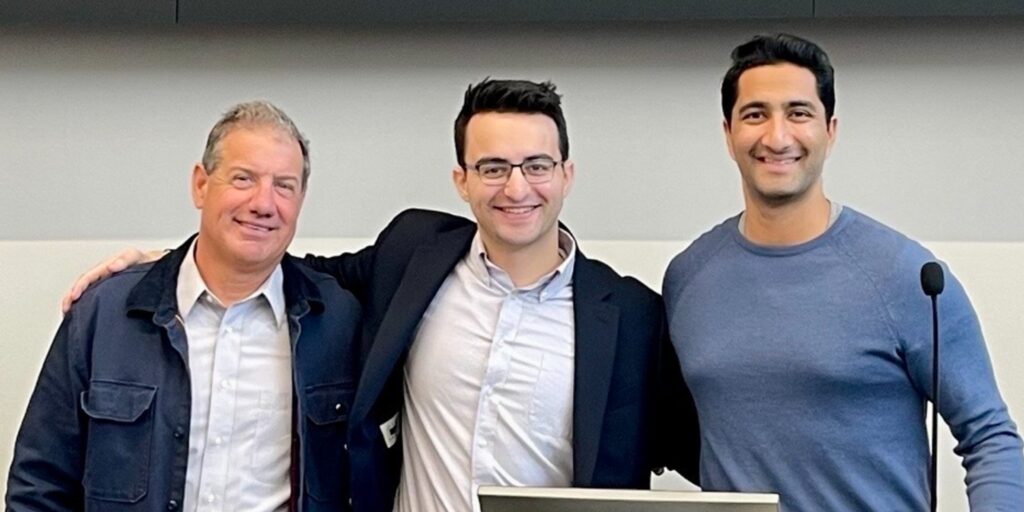
I started asking questions with my co-founder Amit Patankar, a student at Harvard Business School and a former Google Engineer. We went on more than fifty ride-alongs and interviews to understand how officers actually find information in the field.
Those conversations led us to our third co-founder, Michael Gropman, a retired deputy chief who spent more than thirty years in Boston-area law enforcement. Michael was the officer in charge for Brookline during the Boston Marathon bombing. He told us how hard it was, in the middle of a crisis, to access relevant operational guidance and get it to the right people.
What Blue Voice Actually Is
Blue Voice is the trusted, safe AI partner for law enforcement. It pulls together the resources an officer needs, state law, local law, department policy, forms, school maps, and other operational information into a single closed-loop platform. Unlike consumer AI that answers from the open internet, Blue Voice draws only from a department’s own approved materials. Every answer comes back with the exact quote and source, which an officer can click to open to the exact page inside the platform, without ever leaving it.
The difference is not abstract. Asked about a threat to commit a crime, Google indicated that an officer could make an arrest. Blue Voice correctly showed that a warrant was required and pointed to the exact statute the officer could open and verify.
When we ran a real set of field questions asked on Blue Voice through consumer AI tools, they didn’t have the right answer and source on one-third of the questions. Officers deserve purpose-built tools that can answer their questions accurately. Insurers agree and have lowered premiums for our partner agencies.
Blue Voice has since expanded this closed-loop foundation beyond patrol to support workflows across the entire department. Blue Workspace helps detectives work cases, supervisors build tactical plans, and command staff review and draft policy, all inside the same CJIS-compliant, closed-loop system.
Doctors have OpenEvidence. Lawyers have Harvey. Officers now have Blue Voice.
Where We Are Today
Blue Voice is now used by more than 225 agencies across 25 states, growing almost entirely through word of mouth between Chiefs. We’ve grown 10X in the past year and answered over 350,000 questions from officers. Each question, roughly one per minute, directly supports interactions with the public. Here are a few examples from the field:
A landlord was growing aggressive with an officer during an eviction dispute. The officer used Blue Voice to show, calmly, on scene from his phone, that there was no legal authority for him to enforce an eviction. The situation de-escalated.
A rookie officer witnessed a man pressuring a young girl to enter his stopped car. Three months out of the academy, he wanted to make sure he had grounds to intervene. He used Blue Voice to review the elements of the child enticement statute before making an arrest.
In multiple officer-involved shootings, Blue Voice was referenced to make sure the department followed its own policy and the law in the immediate aftermath. This includes mental health protocols that a Chief says would have been missed before Blue Voice.
We hear the impact from our customers. Chief Andrew Amendola of the Carlisle Police Department, one of our earliest partners, put it this way: “Blue Voice has transformed our department, creating a more engaged and knowledgeable police officer on the street and across all levels, no matter the size of the department. This is modern-day policing’s first attempt at a one-stop shop and ultimate solution.”
Why We Are Coming Out of Stealth Now
Officers are already using consumer AI on the job, every day. Much of the public conversation about AI in policing has centered on surveillance technology. But there is a second story that has not reached the mainstream yet, and I believe it will as court cases evolve: officers relying on consumer AI that was never built for this work. Until now, there has been no sanctioned, safe alternative.
We built Blue Voice to be ahead of that curve, a closed-loop platform that can only answer from approved sources, that cites everything, but leaves trained officers in charge of each decision.
Today we are announcing that over the past three years, Blue Voice raised $6 million in funding from SignalFire, Las Olas Venture Capital, Govtech Ventures, and Par Capital during that time. We chose these partners because they understand the long game in public safety. They believe, as we do, that responsible AI improves safety and security for officers and the public, decreases mistakes, and ensures all citizens’ civil liberties are acknowledged and respected.
Where We Go From Here
Our mission is simple: to be the trusted, safe AI partner for every public safety agency in America. If you lead a department, or you serve in one, and you want your officers to always have the right answer in seconds under pressure, we would like to talk. You can reach us at bluevoice.io.
Society should never have to choose between fast decisions and informed ones. We built Blue Voice so it does not have to.
Blue Voice is the CJIS-compliant AI platform purpose-built for law enforcement, giving officers instant, verified access to their department’s own approved laws, policies, and procedures through a secure, closed-loop system. Trusted by 225+ agencies across 25 states. Learn more at bluevoice.io. Connect with Blue Voice CEO David Lawrence on LinkedIn.
